
Is Nepal Safe to Visit After the Rasuwa Flood? What Travelers Need to Know
Updated: September 2, 2026
If you are planning a trip to Nepal after the devastating Rasuwa flood, you may be wondering whether you should cancel your plans.
The short answer is: not necessarily, but you should not treat the current situation as normal either.
A catastrophic flood struck Nepal's northern Rasuwa district on Wednesday, August 26, 2026, destroying homes, roads, bridges, hydropower infrastructure and parts of the Nepal–China border corridor. The damage has also affected communities farther downstream in Nuwakot, Dhading and other districts. Search and rescue operations are still continuing, and some areas remain difficult to reach. This does not mean that every part of Nepal has been affected in the same way.
Nepal is a large country, and travel conditions can be very different from one region to another. But routes, roads and trekking access can change quickly during the monsoon season, particularly in areas affected by floods and landslides.
So the right question shouldn’t be, “Is Nepal safe?”
It should be: “Is my particular destination and route safe and accessible right now?”
What happened in Rasuwa?
On the morning of August 26, a sudden and extremely powerful surge of water entered the Bhote Koshi River in Rasuwa district, close to the Nepal–China border.
The flood swept through areas including Timure, Rasuwagadhi and Syabrubesi, damaging settlements, markets, roads, bridges, police facilities and hydropower projects.
Authorities have investigated the exact chain of events behind the flood since the disaster began. Preliminary assessments by the Nepal Red Cross, drawing on discussions between Nepali and Chinese scientists, indicated that an ice avalanche or related high-altitude event may have blocked the Lhende River upstream before the water was suddenly released. A magnitude 4.4 earthquake was recorded shortly before the flood. The precise mechanism remains under investigation.
For travelers, however, the exact scientific classification is less important than what happened on the ground: a major mountain disaster destroyed critical infrastructure in one of Nepal's northern border corridors.
What is the situation now?
The scale of the disaster has grown far beyond the first reports issued on August 26.
As of September 2, the National Disaster Risk Reduction and Management Authority had reported more than a thousand deaths and thousands of people still missing in the wider disaster, while rescue and recovery operations continued. The Associated Press reported at least 1,127 deaths, more than 4,858 people missing, and 12,000 people rescued, with the figures continuing to change as authorities search affected areas. These figures should not be read as the number of people missing in Rasuwa alone. They reflect the wider disaster and its downstream impact.
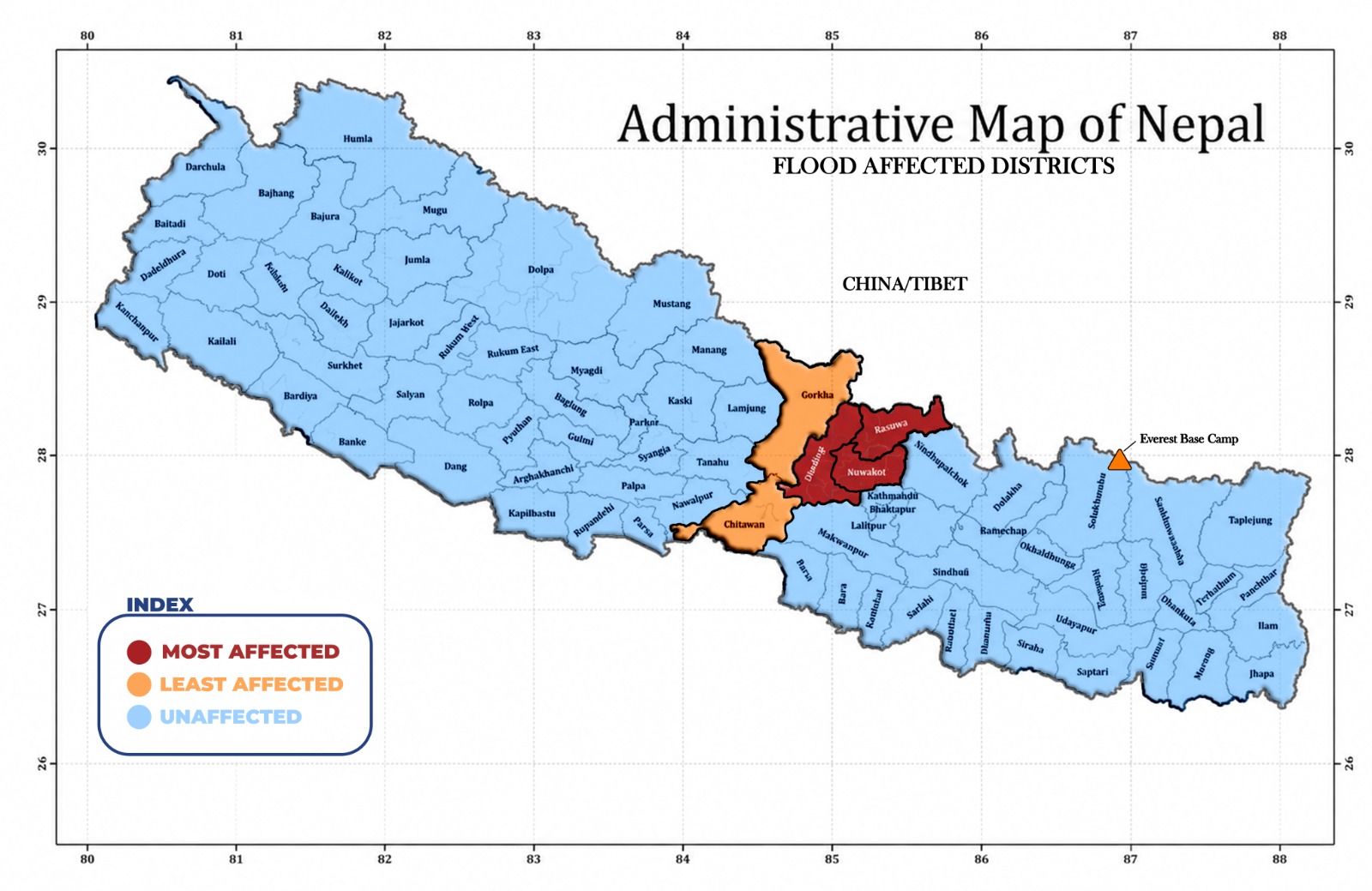
The government has described Rasuwa and Nuwakot as severely affected districts, with around 1.6 million people reported as affected in the latest situation reporting. Search teams are still working in difficult conditions. Damaged roads, unstable slopes, debris and collapsed infrastructure have made access to some areas extremely difficult. Recovery of people trapped in or around damaged hydropower facilities has also been a major part of the ongoing operation.
This is why travel information for the region should be treated as live information, not as something that can be estimated from an itinerary prepared weeks or months ago.
Which parts of Nepal are directly affected?
The worst-affected corridor begins around the Nepal–China border and follows the Bhote Koshi and Trishuli river systems.
Areas directly affected include:
- Rasuwagadhi
- Timure
- Syabrubesi
- Other settlements along the Bhote Koshi corridor
- Parts of Nuwakot
- Parts of Dhading
- Other downstream communities along the affected river systems
The destruction has also affected the road network connecting northern Rasuwa with the rest of the country. Several bridges were destroyed, and alternative access routes are being used while repairs continue.
The Nepal–China border crossing at Rasuwagadhi is therefore not a normal travel route at present.
We currently advise travelers not to travel to the Rasuwagadhi–Timure–Syafrubesi area of Rasuwa, including the Nepal–China border crossing, because of flood damage, disrupted transport and communications, ongoing search and recovery operations, and the continuing risk of flooding and landslides.
That is a specific warning for the affected area. It is not a blanket travel ban on Nepal.
Does the Rasuwa flood mean you should cancel your Nepal trip?
Not automatically. Your decision should depend on where you are going, how you are getting there, and whether your route passes through an affected area.
If your itinerary includes Rasuwa, If your trip includes Timure, Rasuwagadhi, Syabrubesi, especially the Langtang region or routes immediately affected by the disaster, you should not travel there at present unless the relevant authorities have reopened the route and your local operator has confirmed that the journey is safe, which as of now is not recommended.
This is not a situation where an old road condition report, a social-media post or a photograph from before the flood is enough to make a decision.
If your itinerary does not include Rasuwa
A trip to another part of Nepal is not automatically cancelled because of the Rasuwa disaster. However, you still need to check your actual road or flight route. For example, a destination may be far from Rasuwa, but the road used to reach it may pass through an area affected by flooding, landslides or road closures.
What about Kathmandu, Pokhara, Chitwan and Lumbini?
The Rasuwa flood did not strike these destinations in the same way that it struck Timure and Syabrubesi. But that does not mean every road connecting them is automatically operating normally. Kathmandu, Pokhara, Chitwan and Lumbini are geographically separate from the worst-hit Rasuwa corridor. So if your itinerary is:
Kathmandu to Pokhara
Check the road condition before travelling or choose an alternate travel option like flights.
If it is:
Kathmandu to Chitwan
Check the road condition before travelling.
If you are travelling by domestic flight, check your flight status and allow additional time if you have an international connection. Do not assume that because your destination itself is unaffected, the journey there will be unaffected.
What about Everest Base Camp?
The Rasuwa flood does not mean that the Everest Base Camp region has been hit by the same flood. The Everest region is accessed through the Khumbu and is separate from the Rasuwa–Bhote Koshi corridor. If you are travelling to Everest Base Camp soon, check the status of your flight, trail and local conditions immediately before departure.
What about Langtang?
Langtang requires particular care because Rasuwa is the gateway to the Langtang region. The flood severely affected Syabrubesi and the surrounding road network, meaning that even though the higher Langtang Valley is not the same river corridor as the Bhote Koshi flood zone, access to the trekking region has been seriously affected. For this reason, anyone with a Langtang or Gosaikunda itinerary should not simply rely on the statement that “the trail itself was not flooded.” The question is whether the access route, bridges, road, and trail are currently usable and approved for travel.
At the moment, a traveler should wait for clear confirmation from local authorities and an experienced local trekking operator before proceeding.
What are international travel advisories saying?
The advice from foreign governments is useful because it gives travelers an independent reference point.
United States
The U.S. Department of State currently rates Nepal overall at Level 2: Exercise Increased Caution. But it separately gives the Rasuwagadhi–Timure–Syafrubesi area of Rasuwa a Level 4: Do Not Travel warning because of flood damage, disrupted infrastructure, ongoing rescue and recovery work, and the risk of further flooding and landslides.
United Kingdom
The UK's Foreign, Commonwealth & Development Office also warns about the flooding in Rasuwa and the Nepal–China border area. Its current advice notes severe damage to buildings, roads, transport and communications infrastructure, and says that other areas including Gorkha, Nuwakot and Dhading have also been affected. It also warns that the situation can change rapidly. These advisories do not say that tourists should leave Nepal altogether. They do, however, make one thing clear: The affected northern corridor should not be treated as an ordinary tourist route right now.
If you are already in Nepal
If you are already travelling in Nepal, there is no need to panic. Instead, check your itinerary carefully. If your current location is outside the affected region:
- Ask your hotel or local operator about current road conditions before a long overland journey.
- Check for official road and weather updates before leaving.
- Keep some flexibility in your itinerary.
- Avoid travelling close to swollen rivers.
- Do not cross damaged bridges or roads simply because other vehicles appear to be doing so.
- Keep your travel insurance information and emergency contacts accessible.
- If you are trekking, stay with your group and follow instructions from your guide and local authorities.
- If you are already in or near an affected area, follow instructions from the authorities rather than attempting to inspect the damage yourself.
We specifically warns people not to enter the disaster area independently to search for missing people.
If your trek starts soon, ask these questions before you leave
If you have a trekking or tour itinerary scheduled in the coming days, ask your operator for a current answer to each of these:
1. Is the road to the trailhead open?
Do not accept “it should be fine.” Ask for the current situation.
2. Are the bridges on the route intact?
This matters particularly in mountain regions after major floods.
3. Is the trail officially open?
A trail appearing on an old itinerary does not mean it is currently accessible.
4. Are local authorities allowing visitors to enter the area?
This should come before any tourism consideration.
5. Are lodges and accommodation operating normally?
A route may technically be passable while accommodation, food supply or communications remain disrupted.
6. Is there a safe alternative route?
If there is, ask how much additional time and cost it involves.
7. What happens if the route becomes unsafe after departure?
Your operator should have a clear plan for turning back, changing routes or arranging transport.
What travelers should not do
The Rasuwa disaster is not a sightseeing opportunity. Please do not travel into restricted areas simply to see the destruction.
Do not:
- Enter closed roads or restricted disaster zones.
- Walk across damaged bridges.
- Cross swollen rivers or streams.
- Approach unstable riverbanks or slopes.
- Ignore police or local-government instructions.
- Follow an old Google Maps route without checking current road conditions.
- Rely on unverified social-media posts for safety decisions.
- Travel into an affected area independently to look for missing people.
- Assume that because a road was open yesterday, it will be open today.
- We specifically advise travelers to stay away from riverbanks, low-lying areas, damaged bridges and unstable slopes in the affected region.
How is Nepal responding?
Search, rescue and relief work has involved multiple government agencies and humanitarian organisations. The Nepal Army, Nepal Police and Armed Police Force have been involved in search and rescue, evacuation and recovery operations. The Nepal Red Cross Society has also mobilised volunteers and emergency assistance, including relief supplies and medical support.
At the same time, support has come from far beyond the affected areas. People across Nepal and around the world have been contributing to relief efforts, including donations to the Prime Minister’s Disaster Relief Fund, while individuals, businesses, community groups and organisations have been collecting and sending essential supplies directly to affected communities.
In many cases, this support has gone beyond financial donations. People have come together to provide food, drinking water, clothing, medicines, sanitary products and other basic necessities for families who have lost access to their homes, businesses and livelihoods. Local communities and volunteers have also been helping with the distribution of these supplies and supporting those who have been displaced.
We have also contributed to the relief effort, collecting support from our own network and using it to provide essential food, clothing, medicines, sanitary products and other necessities to people affected by the disaster. It is a small contribution in the face of the scale of the loss, but it is our way of standing with the communities that have been part of Nepal's tourism landscape and, more importantly, are now going through an incredibly difficult time.
The scale of the operation has changed as authorities have reached areas that were initially difficult to access. The immediate focus has been on finding people, evacuating those in danger, and getting essential assistance to affected communities. Recovery, however, is likely to take much longer than the immediate rescue operation.
For local communities, this is not simply a road closure or a temporary interruption to tourism. Homes, businesses, infrastructure and livelihoods have been lost. Roads and bridges may take time to restore, and for many families, returning to normal life will be a much longer process.
That is important context for anyone deciding whether and how to travel through affected areas. While tourism will eventually play an important role in helping local economies recover, travel decisions should be made with respect for the situation on the ground and with the safety and wellbeing of affected communities in mind.
What should you do if your trip is in the next few weeks?
Do not make the decision based on the name “Nepal” alone. Look at your itinerary line by line.
You can consider continuing your trip if:
- Your destination is outside the affected area.
- Your route does not depend on a damaged road or bridge.
- Your airline, hotel or trekking operator confirms that services are operating.
- Local authorities have not issued restrictions for your route.
- You have adequate travel insurance.
- You are prepared to change plans if conditions deteriorate.
You should postpone or change your itinerary if:
- Your route passes through the restricted Rasuwa corridor.
- You need to travel through a closed or damaged road.
- Your trek requires access through an affected trailhead that has not reopened.
- Your operator cannot confirm the current condition of the route.
- Authorities advise against travel.
- You would have to take unnecessary risks simply to keep the original itinerary.
In other words, do not cancel Nepal simply because of a headline, but also do not ignore a real warning because you have already paid for your holiday. Your safety comes first.
Is Nepal still open to tourists?
Yes, Nepal has not been closed to international tourists as a whole. But “Nepal is open” should never be interpreted to mean that every road, trekking region or border route is open. Nepal's tourism destinations are spread across a country of very different landscapes, river systems and road networks. Conditions can vary considerably between regions. The current situation is therefore best understood as, Nepal remains a tourist destination, while some areas and routes are severely affected by the flood and should not be visited.
A note for travelers planning Nepal in September and October
September marks the transition out of the main monsoon period, and October is traditionally one of Nepal's busiest trekking months. That does not mean that every trail will immediately return to normal after the floods. Road repairs, bridge reconstruction, landslide clearance and restoration of services can take time.
If you have a trip planned for the coming weeks, stay in contact with your trekking or tour operator rather than making a decision months in advance and assuming that nothing will change. The situation may improve quickly in one area and remain difficult in another.
Emergency contacts in Nepal
For travelers who are already in Nepal, keep the following numbers accessible:
Police: 100
Tourist Police: 1144
Government emergency information line: 1234
The current UK travel advice confirms the 1234 Nepalese-language emergency number and 1144 hotline, while the U.S. Department of State lists 100 for police and 1144 for Tourist Police.
If you are in an immediate emergency, contact the appropriate local authority rather than relying on social media for assistance. The most important thing to remember is that the Rasuwa flood does not make every corner of Nepal unsafe. But the fact that your destination is somewhere else in Nepal does not mean you can ignore the disaster either.
A traveler going to the Everest region, for example, is dealing with a different geographical corridor from someone travelling towards Rasuwagadhi. A visitor staying in Kathmandu is in a very different situation from someone attempting to reach Timure. At the same time, roads connect these places, and those roads can be affected by floods, landslides and other monsoon hazards. So make the decision based on your actual route, current local conditions and the latest official advice. And if your plans take you through an area where people are still being rescued or where communities are rebuilding, postponing the trip is not an inconvenience. It is the responsible choice.
Planning a trip with Footprint Adventure?
If you already have a trip booked with Footprint Adventure and are unsure how the current situation affects your itinerary, our team can review your route with you and explain the available options. Depending on the destination and current conditions, this may mean keeping your original itinerary, changing the route, postponing part of the trip, or making other arrangements. We will always put the safety and practical needs of our travelers first.
Footprint Adventure
Kathmandu, Nepal
WhatsApp/Viber: +977 9851221603
Email: [email protected]
Our thoughts are with the people of Rasuwa
The Rasuwa flood has taken lives, separated families and caused enormous damage to communities that have already endured a difficult monsoon. For now, the priority is the people affected by the disaster and the teams working to find, rescue and support them. If you are travelling in Nepal, stay informed, respect access restrictions and give rescue and recovery teams the space they need to work. If your journey takes you elsewhere in the country, make your decision based on your own route and the latest verified information, not on assumptions about Nepal as a whole.
Our thoughts remain with everyone affected by the Rasuwa disaster, their families, the local communities, and everyone still waiting for news of their loved ones.
Frequently Asked Questions
Is Nepal safe to visit after the Rasuwa flood?
Nepal is not uniformly affected by the flood. The Rasuwagadhi–Timure–Syafrubesi corridor is severely affected and is currently subject to a U.S. “Do Not Travel” warning. Other parts of Nepal may be accessible, but travelers should check their specific route and current local conditions before travelling.
Should I cancel my Nepal trip because of the Rasuwa flood?
Not necessarily. If your itinerary does not pass through an affected area and your transport routes are operating, you may be able to continue your trip. If your itinerary involves Rasuwa or an affected access route, you should postpone or change your plans until authorities and your local operator confirm that travel is appropriate.
Can tourists travel to Rasuwa right now?
Travel to the worst-affected Rasuwagadhi–Timure–Syafrubesi area should not be treated as ordinary tourism at present. The U.S. Department of State currently advises against travel to this area because of the damage, ongoing recovery work, and continuing flood and landslide risks.
Is the Everest Base Camp trek affected by the Rasuwa flood?
The Everest region is separate from the Rasuwa–Bhote Koshi flood corridor. However, Everest trekkers still need to check current flight, weather and trail conditions before departure, particularly during the monsoon transition.
Can I still visit Kathmandu and Pokhara?
These destinations are not the same as the directly affected Rasuwa corridor. However, road conditions elsewhere in Nepal can also change after floods and landslides. Check the specific road or flight route before travelling rather than assuming that the entire journey is clear.
Is Langtang open after the Rasuwa flood?
Langtang requires particular caution because Syabrubesi, an important gateway to the region, was badly affected. Travelers should not rely on pre-flood access information. Check current road and trail conditions with local authorities and a registered trekking operator before departure.
What caused the Rasuwa flood?
Preliminary assessments indicate that a high-altitude ice and rock event may have contributed to the sudden release of water into the Lhende and Bhote Koshi river system. The Nepal Red Cross has reported that the precise cause remains under investigation.
What should I do if my tour or trek is scheduled soon?
Contact your operator and ask specifically about road access, bridges, trail conditions, accommodation, local restrictions and alternative routes. Do not rely only on an itinerary prepared before August 26.
Where can I get help in Nepal?
Police can be reached at 100, Tourist Police at 1144, and the government has established 1234 as a Nepalese-language emergency information line.