Who Built Swayambhunath Stupa and When
The Licchavi King Vrsadeva established the first physical Swayambhunath Stupa in approximately the early to mid-fifth century CE, or approximately between 400–460 CE. Evidence supporting this claim is found in a broken inscription found at the Swayambhunath site as well as in the Gopalarajavamsavali historical document, which was written many years after King Vrsadeva's time.
.jpg)
There are also various Buddhist legends about the stupa appearing from under a lotus flower on top of Swayambhunath Hill more than 2,500 years ago, but the physical construction of Swayambhunath Stupa is attributed to King Vrsadeva's time as well. Swayambhunath Stupa became the first established physical stupa. After this, King Vrsadeva's grandson King Manadeva (464–505 CE) made the first renovation of Swayambhunath Stupa as seen in the inscription on the stone in 640 CE. After this time, Swayambhunath continued to grow and develop into a centre of Buddhism in Nepal during the 13th century. Many years later, it underwent a major reconstruction by the Indian monk Sariputra in the 15th century, and gained its eastern staircase, built by King Pratap Malla in the 17th century.
Why is Swayambhunath Stupa Called Monkey Temple?
Swayambhunath Stupa in Kathmandu contains roughly 500 wild rhesus macaque monkeys. The Buddhist legend states that Manjushri built the Swayambhunath Stupa while draining the lake that was located in the Kathmandu Valley at one time. The legend claims that the lice in Manjushri's long hair transformed into monkeys as he raised the hilltop where the stupa stands.
.jpg)
The monkeys are found primarily in the northwest part of the stupa complex and are recognized as guardians of the site. Over time, they have thrived on the forested hill, feeding on offerings from pilgrims and water sources around the complex. Today, about 200–300 monkeys roam freely, and the temple and hill are also home to wandering monkey families. Because of this large monkey population, Swayambhunath is commonly known as the “Monkey Temple.” Additionally, the name Monkey Temple is commonly used by foreign visitors.
How to Reach Swayambhunath Stupa?
From Thamel by Taxi or Rideshare
Taxis from Thamel to Swayambhunath typically cost between 350-500 NPR ($3-$4 USD), based on your pickup location. You can also use a ridesharing app like Pathao and Indrive to check pricing and book a ride. If you are traveling during a busy hour (9-11 am / 4:30- 6:30 pm), it is recommended that you confirm the cost with the driver before starting.
From Thamel on Foot
You can also take a leisurely walk to Swayambhunath while experiencing the local life of Nepal. The easiest route is from Chhetrapati, where a small road leads directly to Swayambhunath and passes by the Hotel Bajra. If you are coming from Jhochhe or Kathmandu Durbar Square, take the lane that goes northwest from the Maru Ganesh Shrine. It usually takes about 20–25 minutes to walk from Thamel to Swayambhunath temple, so it's best to wear comfortable footwear and carry some water with you.
From Tribhuvan International Airport
Taxis from the airport to Swayambhunath Stupa cost around 780 NPR ($7). Be aware that airport taxis may charge additional fees for luggage, so check with them before leaving for Swayambhunath.
Height and Architecture of Swayambhunath Stupa
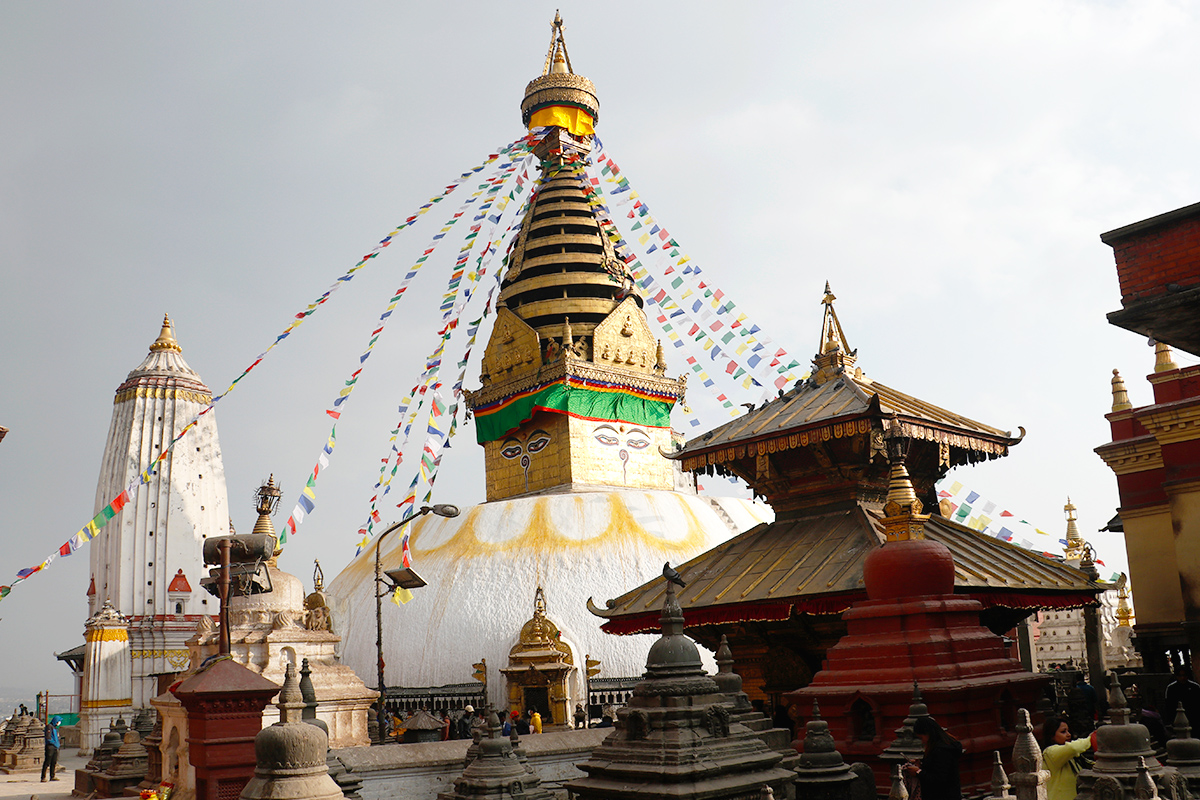
The Swayambhunath Stupa is about 36 meters tall from bottom to top, making it really noticeable across the Kathmandu Valley. This height represents the spiritual path from the material world towards enlightenment. As the stupa ascends step by step, it reflects a person's journey from ignorance to gaining wisdom.
.jpg)
The Dome
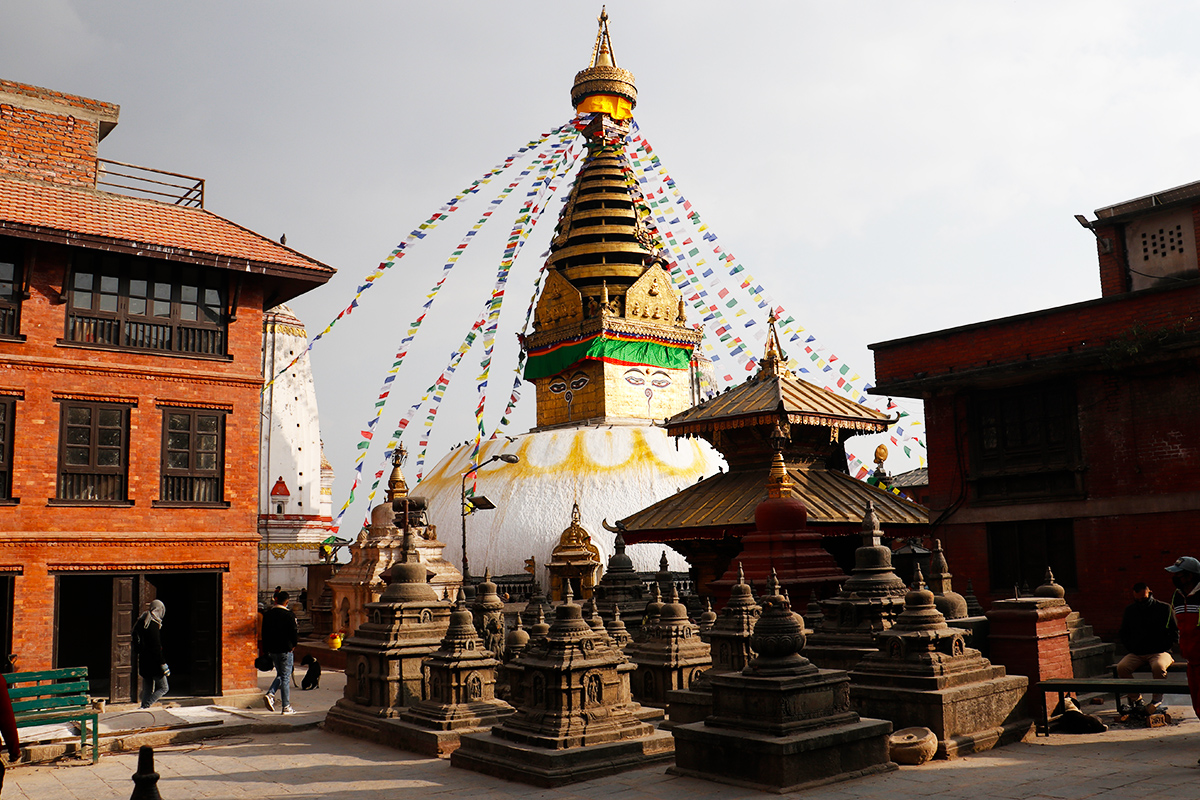
At the bottom of the stupa, you'll find the white, rounded dome, which is the largest part of the stupa. It's made from a mix of soil and clay and then coated with a smooth white lime plaster. This dome represents the ground element and also symbolizes the mandala of the five cosmic elements: ground, water, fire, air, and ether.
The dome represents both the universe and the human mind. Its shape symbolizes purity, completeness, and the potential for enlightenment. Surrounding the dome, you'll find statues of the Pancha Buddhas, also known as the Five Dhyani Buddhas. Every Buddha there represents a different cosmic element and shows a special hand mudra that reflects their spiritual strength in Vajrayana Buddhism.
The Harmika
The harmika is a square platform with four openings above the dome of the stupa. In Buddhist cosmology, the harmika represents not only the physical representation of Earth, but also stability and direction. Each side of the harmika faces one of four cardinal points: north, east, south, and west.
Also painted on the harmika are the "All-Seeing Eyes" or Eyes of the Buddha. These all-seeing eyes represent the capacity of the Buddha to see everything in all directions, as well as his infinite wisdom and compassion in caring for all things in the universe. Underneath each set of the Eyes is a Nepali 1, which represents a single ultimate truth that all spiritual paths converge upon.
The Thirteen Golden Tiers (Trayodashabhuvana)
Above the harmika sits the golden spire called Trayodashabhuvana, which has thirteen gold rings gradually decreasing in size towards the top of the spire; these tiers represent the 13 stages of spiritual development needed to attain Buddhahood or Nirvana.
The colour gold represents purity, enlightenment, and absolute wisdom. Each tier represents progress towards the goal of spiritual growth. As the spire rises into the sky, it leads the observer's mind toward higher consciousness.
The Umbrella, Crescent Moon, and Sun
At the top of the spire is a bowl covered by a golden umbrella. This umbrella shows respect, spiritual protection, and the final stage of reaching enlightenment. Above the umbrella are the crescent moon and the sun. These two symbols show the balance between feminine and masculine energies and the harmony between wisdom and compassion. In Vajrayana Buddhism, the moon and sun also represent the path from emptiness to the creation of the universe and the achievement of enlightenment.
The Mandala Platform
The whole stupa is built on a three-tier platform designed like a mandala. These levels represent the universe's structure in Buddhist beliefs. Each level signifies different realms and helps set a sacred atmosphere around the monument. In addition to that, the elevated platform provides a sturdy base for the stupa, but also makes it easily visible from a distance, highlighting its significance as a spiritual hub.
Shrines and Guardian Statues
There are numerous small shrines and guardian statues located along and around the stupa. Each statue represents a different example of a Buddhist figure while protecting the temple. Some statues can be found at entryways, on pedestals, and adjacent to the stupa itself. Visitors to Swayambhunath frequently stop at a shrine to make offerings, burn candles, or spin prayer wheels; these activities help contribute to the temple's spiritual ambiance.
The 365 Steps
The 365 steps to Swayambhunath were built in the 17th century by King Pratap Malla. The stairs lead up to the stupa on the eastern side of the hill. Many visitors climb slowly, enjoying the views and stopping at the small shrines along the way. At each shrine, you can spin prayer wheels and offer prayers at small statues of Buddhist deities. The steps symbolize the effort and dedication required to reach enlightenment.
Major Attractions at Swayambhunath Stupa
Climb the Vajra
When you reach Swayambhunath, the first thing you'll see is the vajra (lightning bolt) placed on the mandala, which is surrounded by carved animals. According to legend, there's a well under the vajra that used to depict all of the souls that had died; as such, it was covered so as not to create any hazards. The vajra is the first landmark in your journey to the stupa and shapes the spiritual experience ahead.
.jpg)
Explore the Stupa
The stupa itself is characterized by a round, solid dome that has undergone numerous repairs throughout history. In the 14th Century, Mughal horsemen damaged the dome in their attempts to seek out gold; British Army personnel then later discovered gold hidden close by. The stupa has four sides, each decorated with an eye; some refer to them as being the eyes of the Buddha, whereas others view them as being the Lokpal protectors of the universe. To the right of the stupa, you will find brass prayer wheels which you may spin as you recite "Om Mani Padme Hum".
Stop at the Valley Viewpoints
Around the stupa, there are platforms overlooking the Kathmandu Valley with panoramic views of Kathmandu and the hills in the surrounding. From these locations, the views vary depending on the weather and air quality.
Visit the Five Elements Symbols
As you walk around the Anantapur Temple, there is a small shrine dedicated to one of the five elements called Vasupura (Earth). There are also shrines for the other four elements located around the stupa. Each of these five elements represents an aspect of Buddhism. The female form represents Wisdom. Female and male representations together illustrate the path towards enlightenment.
Explore Swayambhu Buddhist Museum
The Buddhist Museum is located in a small red-brick building in the southwest corner of the Anantapur Temple complex. The Buddhist Museum was slightly damaged during the earthquake but is now open to visitors. Inside the museum, you will find many Buddha statues and relics that demonstrate the local history of Buddhism.
Dongak Chhyoling Old Monastery
Next to the museum is the Dongak Chhyoling Monastery. Visiting the monastery is free. The monastery suffered minor damage during the 2015 earthquake, and monks continue to pray at the monastery. Monks can frequently be seen walking around the main stupa in the evening while chanting, and visitors can also join them.
Harati Temple (Ajima Temple)
Shortly after walking from the monastery, you will find the Harati Temple, which features two floors. Photos are not allowed to be taken inside the shrine, but you may take photos from outside of it. The goddess Harati represents smallpox, which causes this disease and provides the remedy for it. The original statue was destroyed by King Rana Bahadur Shah when his wife died, but it has been replaced with a replica statue. It is an extremely important place of worship for Buddhists and Hindus alike.
Visit Pratapura and Anantapur Temples
The Pratapura Temple is located directly in front of the monastery and was rebuilt after suffering damage from fires and lightning strikes. On the opposite side of the Pratapura Temple is the Anantapur Temple, which was destroyed during the earthquake and has been rebuilt recently. Both temples illustrate the development of the architectural style of Swayambhunath over time.
Walk by the Buddha Park
As you walk westward down the main path towards Swayambhunath Road, you will come to Buddha Park, which contains three statues of gold: Buddha standing in the middle, Avalokiteshvara standing to the right, and Padmasambhava (Rinpoche) standing to the left. Surrounding Buddha Park are many more small shrines. It is a peaceful place in which to walk around, meditate, and photograph.
Key Gods and Deities at Swayambhunath Stupa Complex
Swayambhunath Stupa contains numerous important Buddhist and Hindu deities. Adi-Buddha is depicted in the central, main stupa and is described as a self-created Buddha, while the four sides of the Stupa contain the five Dhyani Buddhas: Akshobhya representing East, Ratnasambhava representing South, Amitabha representing West, and Amoghasiddhi representing North, with Vairocana depicted in the Center. Many small chaityas located throughout the area also contain representations of these same Buddhas.
.jpg)
To the northwest of the stupa lies a shrine dedicated to Hariti (Ajima), the protector of children. Statues of Tara, Avalokiteshvara, and Manjushri are located within the monasteries around the complex. Many smaller versions of these same deities can also be found on the chaityas and stairways leading to the summit of the temple complex.
The overall site also features various Hindu shrines. On the west side of the stupa, there is a small temple dedicated to Saraswati, the Goddess of knowledge and learning. Stone carvings of Narayana and other forms of Vishnu can be found in different places, and Shiva Lingas can also be found near the stairs up to the main stupa and within the wooded areas.
Other prominent features of the stupa include the large "Eyes of the Buddha" (which are painted on the four sides of the stupa) and the giant Vajra located on the east side of the stupa, as well as many different chaityas that contain images of many different Buddhas and Bodhisattvas.
Swayambhunath Stupa Entrance Fees and Opening Hours 2025/2026
Swayambhunath Stupa is open daily from 6:00 AM to 6:00 PM. Foreign visitors must buy an entry ticket before entering. Tickets are available at the ticket counter near the main eastern staircase, which is the primary entrance used by most visitors.
| Visitor Category | Fees (NPR) |
| Foreign nationals | 200 |
| SAARC nationals | 50 |
| Nepali Citizens | Free |
Best Time to Visit Swayambhunath Stupa: Weather and Crowds
Swayambhunath Stupa can be visited in all seasons, as there is no specific “best” time to visit the site. The site remains open throughout the year, and each season offers a different experience. Weather changes, but none of the seasons make the visit impossible.
However, crowds vary by time and month. The stupa is usually most crowded in the mornings between 9:00 AM and 12:00 PM, especially on weekends, public holidays, and during important Buddhist festivals such as Buddha Jayanti. Tourist numbers also increase from September to November and March to May, making these periods busier. Early mornings and late afternoons are usually quieter.
Essential Tips for Visiting Swayambhunath Temple
- To avoid large crowds, it is best to arrive either early in the morning or during the late afternoon hours when there are typically fewer people.
- The eastern staircase is the best way to get to the stupa as it's the main entrance to the site, although please be careful because it does have steep stairs.
- All foreign nationals must first buy an entrance ticket at the counter that is located at the eastern stair entrance before entering the site.
- As you walk around the stupa in a clockwise direction, be sure to turn the spinning prayer wheels in a customary manner of circumambulating like Buddhists do.
- You should dress modestly, covering your shoulders and knees, as this is a holy site.
- Monkeys can frequently be found in and around the stupa, so please don't feed them, and keep any food or personal belongings safe.
- Before entering a small or indoor temple, please remove your shoes as shoes are not permitted within the temple.
- Bring plenty of water and wear proper footwear because some paths and steps may be uneven or slippery, especially in wet conditions.
- You may take photographs around the stupa; however, be respectful and do not take photographs inside any of the shrines, where photography might be prohibited.
- When you see other people praying or participating in ceremonies at the stupa, please step to the side quietly so as not to disturb them and be respectful.
Conclusion
The Swayambhunath Stupa, located in Nepal, is one of the most significant sites for practicing Buddhism in Nepal, as well as one of the most prominent heritage sites located in the Kathmandu Valley. Visitors to Swayambhunath Stupa can gain insight into the cultural development of the Kathmandu Valley through the site's history and legends and the actual structure of Swayambhunath Stupa.
In addition to being among the most beautiful places in the Kathmandu Valley, the Monkey Temple in Kathmandu is also home to a number of shrines and monasteries, and is a great place for tourists to take pictures of the surrounding area. The site offers a panoramic view of the city of Kathmandu, and the many prayer wheels around the temple are some of the different ways local people practice their religion at Swayambhunath.
Visitors can appreciate the site with a better understanding by looking into the building's history and construction, including how high it is. The Swayambhunath temple can be reached from a well-defined path and is easy to access.
Swayambhunath is an essential place to visit during your time in Kathmandu, and if you would like us to arrange a Swayambhu tour for you as part of one of our full-day tours of the Kathmandu Valley, or as part of a smaller half-day tour or customized tour based on your travel plans, we are happy to do so. Feel free to contact us.
Frequently Asked Questions
How many steps are there to climb Swayambhunath Stupa?
The eastern staircase to the Swayambhunath stupa consists of roughly 365 steps. Most people reach the top of the Swayambhunath between 10 - 15 minutes, depending on how fast they are walking.
What is the significance of the eyes painted on the Swayambhunath Stupa?
The painted eyes of the Swayambhunath stupa represent the all-seeing wisdom of the Buddha. The symbol that sits between the two eyes is the Nepali numeral "1" symbolising unity and our path toward enlightenment.
Can visitors participate in prayer rituals at Swayambhunath?
Yes, visitors can walk clockwise around the stupa, spin prayer wheels, light butter lamps, and pray simply along with other devotees in the area.
What local foods or snacks can you try near Swayambhunath?
You will find a selection of restaurants and food stalls offering keema noodles, Tibetan-style thukpa noodles, and laphing noodles, plus local cafes throughout the area. Many of the small cafes located around the viewing platform offer delicious Tibetan-Nepali dishes that are popular with both locals and tourists alike.
Can you do meditation or yoga at Swayambhunath?
Yes, many visitors to the Swayambhunath stupa practice meditation, both in the open areas of the stupa and at less frequented locations on the hill. Morning time is best for meditating since it provides a peaceful and less populated environment.
Are there any sunset or sunrise viewpoints from the Stupa?
The Stupa Hill is a great place to watch the sunsets and sunrises because it has great views of the Kathmandu Valley. They are popular for both of these experiences, with the sunrise typically being less crowded than the sunset.
Is Swayambhunath safe for solo travelers or women travelers?
The Swayambhunath is generally considered a safe area, particularly because of the number of tourists that visit the area and therefore it is also busy and crowded during daytime hours. Be mindful of your belongings and keep them secure. Just like any other Tourist destination, safety is always recommended.
Do I need a guide to visit Swayambhunath Stupa?
A guide is not necessary to visit, but you may find it helpful to have a guide to help us learn more about the history, the different deities and rituals, to give you a more enhanced experience.
How long does it take to explore Swayambhunath Stupa fully?
The average time to visit the area is between one and two hours, but that can vary depending on how much time you want to spend at the various shrines or how many steps you are going to be walking up to the various areas. If you want to visit some of the nearby monasteries, that could take quite a bit more time.
Can I combine Swayambhunath with other Kathmandu sightseeing in one day?
Yes, Swayambhunath is located very near to Kathmandu Durbar Square, Patan, and Thamel. Therefore, if you want to take a half-day or full-day tour, it can easily be included. We can customize your visit, whether you prefer to go on a tour or just want transportation or specific sightseeing options.

.jpg)